
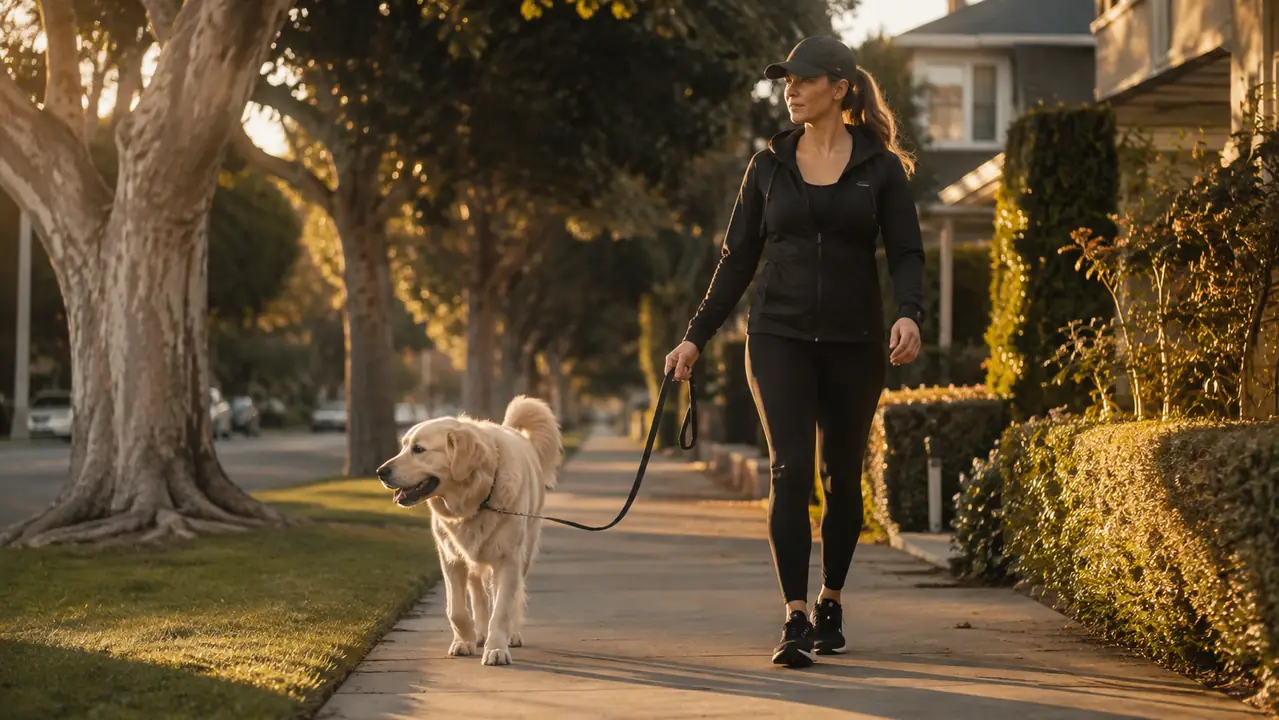
If you have ever walked a strong-pulling dog, you know the exact moment the walk stops being a walk. You are leaning back, the leash is stretched flat, and your shoulder is doing the work while the dog steers the whole trip with its nose. I have spent years around dogs and cats, and the puller problem is the one that sends more owners to the pet store than just about anything else. They come home with a flat collar, or a back-clip harness that makes the pull more comfortable for the dog. Nothing changes.
The rabbitgoo no-pull harness is a different answer. It has a second leash clip on the front of the chest, and that small detail changes the physics of a walk. Instead of stacking your strength against the dog's, the front clip turns the pull sideways and takes you out of the tug-of-war. It is one of the best-reviewed dog products on Amazon, over 196,000 ratings at the last count, so I wanted to see whether the numbers match reality. I walked a strong puller with it for six weeks. This is the long version.
The Quick Verdict
The front clip genuinely takes the strain out of walks with a puller, and the padded fit is comfortable enough to forget you are wearing it on the dog. But it is a walking tool, not a training cure. You still teach the loose-leash habit. This harness just makes that lesson far easier.
Amazon Check Today's Price →The front clip that turns a puller back into a walker
The second leash clip on the rabbitgoo harness does the one thing a collar and a back-clip harness cannot: it gives the pull somewhere to go that is not your shoulder. Priced well below most no-pull harnesses, it is the cheapest real change I have made to walking a puller in years.
Amazon Check Today's Price on Amazon →How I've Used It
For this test I used the rabbitgoo on a large dog that is exactly the kind of puller this harness claims to fix: strong, determined, and happy to hit the end of the line and stay there. I walked the same route at the same time of day for six straight weeks, flipping between the front clip and the back clip so I could tell what each one was actually doing. I also washed it, left it clipped to the leash in the car, and generally treated it the way a harness in daily use gets treated.
One honest note on how I work. I am not a trainer and I am not a vet. What I can tell you is how a harness behaves over weeks of real walks: how it fits, how it holds up, and how much of the pulling it takes away on its own. If your dog's pulling is extreme, or walks have started to feel unsafe, a professional trainer is the right next step and that is not something any harness can replace. This piece is about the gear itself.
What the Two Leash Clips Are Actually For
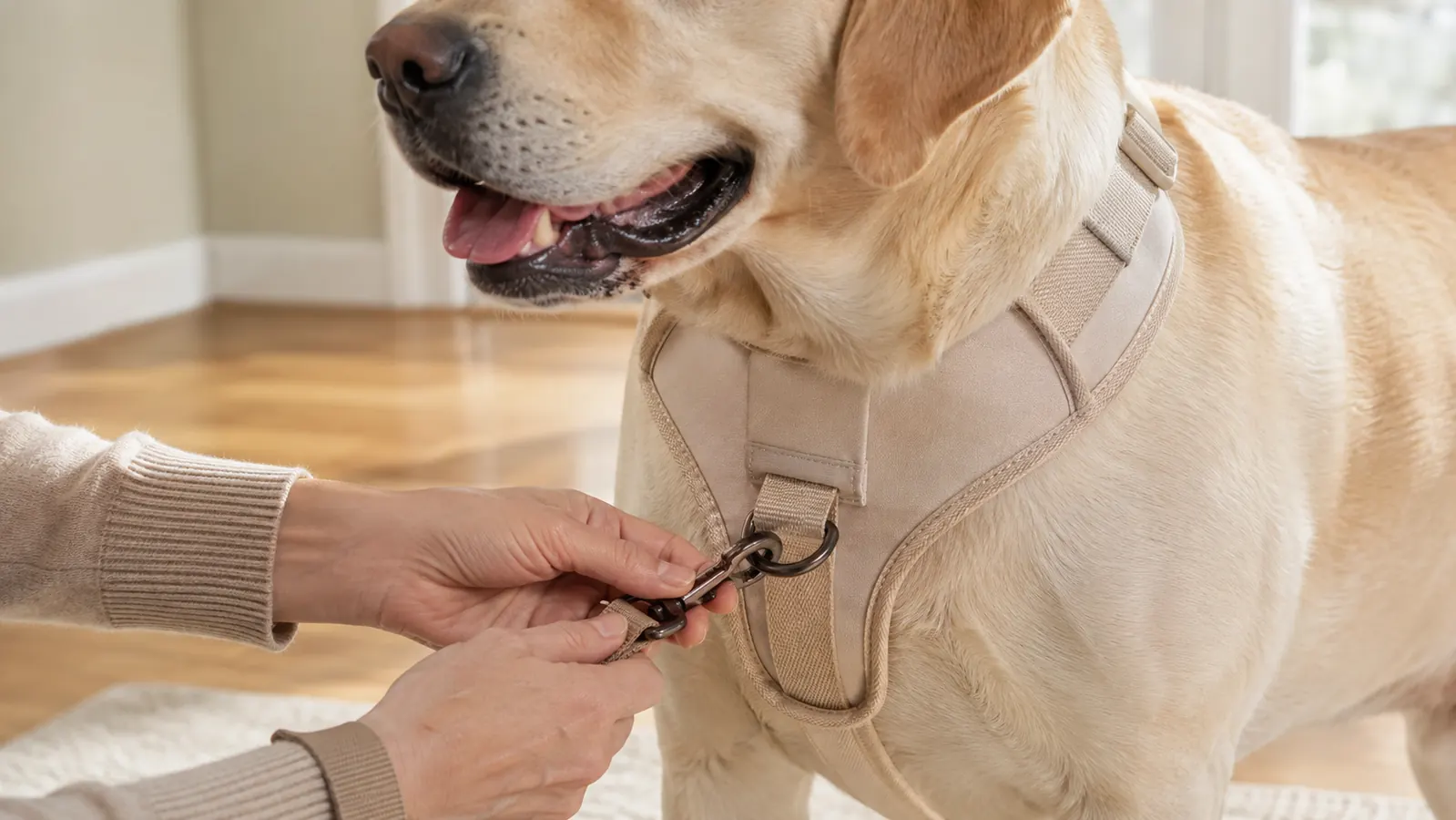
Most harnesses have a single clip on the back, right between the shoulder blades. That position is comfortable for the dog and useless for pulling. When a dog hits the end of a back clip, the harness absorbs the force along its strongest line, and the dog keeps pulling with the full weight of its body behind the push. All the hardware in the world does not matter because the geometry of the pull never changes.
The rabbitgoo adds a second clip on the front of the chest, around the sternum. Clip the leash there and something clever happens. When the dog surges forward, the front connection redirects the line so the dog's own momentum swings its chest to the side. The dog ends up turning back toward you instead of dragging you down the road. You are not stronger than the dog. You are pointing its strength in a direction where it cannot brace against you, and that is a completely different fight.
The back clip is still there for calm dogs and easy days, and honestly that dual setup is the best part of the design. One harness, two modes. Front clip on the busy streets and the wild mornings, back clip when the dog is already moving loose-leash and you just want a comfortable walk. You are not buying two separate pieces of gear.
The front clip turned the worst part of the day, the first minute of full-strength pulling, into something I could hold with one hand.
What Actually Changed on the Walks
The first few walks, the dog still pulled. The harness does not reach into the brain and switch off a habit that has been rehearsed for years. But the pull felt different from day one. Instead of a straight line of force running from the dog to my shoulder, the dog's chest swung sideways the moment the leash tightened, and the walk became a series of small corrections instead of one long tug-of-war. That difference is the entire point of the front clip.
By week two I was walking with a relaxed hand. That sounds like a small thing, but it is the whole deal. A harness that moves the fight from your shoulder down to a subtle nudge is doing its job. By the end of the six weeks the front clip had become my default, and the dog had quietly learned that surging forward means turning back around to face me. That is not magic. It is repetition with a better tool, and the better tool matters.
I want to be straight about the limits. The rabbitgoo removed most of the strain from the walk, but it did not and cannot do the training. A dog that pulls because it is anxious, reactive, or simply never learned any other way still needs a trainer and a structured plan. What the harness does is make the loose-leash lesson actually learnable, because the dog stops getting the reward it used to get for hitting the end of the line.
Fit, Comfort, and the Handle
The rabbitgoo is a vest-style harness with soft padded panels and several adjustment points, which matters more for fit than most people realize. Dogs come in odd shapes, deep-chested and barrel-bodied, and a one-size harness either chokes at the neck or flops around the ribs. The rabbitgoo adjusts around both the neck and the chest, and I was able to set it snug enough that nothing shifted or rubbed, with two fingers still sliding under the straps. That fit is the difference between a tool the dog forgets about and one it fights.
The handle on top deserves its own mention. I use it constantly, at street crossings and any time I want the dog close for a few steps. Grab the handle, step the dog next to me, cross. It saves bending down to the collar, and it gives an instant physical connection at the moments you need the dog right beside you. The grab handle on a large puller is one of those features you do not know you need until you have it.
The reflective stitching is real and not just decoration. On evening walks in fading light, the dog's outline shows up in headlights well before the body would otherwise. And because this is a harness rather than a collar, a sudden surge lands on the chest and shoulders instead of the throat. For a dog that still lunges at the occasional squirrel, that is easier on the dog and calmer for you.
Where the rabbitgoo Comes Up Short
The honest tradeoffs. The front clip solves the pull, but it changes the dog's gait at speed. On a dog that trots hard, the front connection can make the front legs step a little awkwardly while the steering tugs the chest sideways. The dog adjusts within a couple of walks, and most owners never notice it, but if your dog sprints flat out on every outing, a back-clip harness or a different design may suit it better.
The vest-style fit also means measuring carefully before you buy. The rabbitgoo is sized for large dogs, and if you land between sizes, the larger one is the safe pick, because the whole no-pull mechanism depends on that front panel sitting squarely against the chest. A vest that is too small pinches in front of the shoulders, and then nothing works the way it should. Measure the widest part of the chest and take the number seriously.
And the materials are no-frills. This is a workhorse piece of gear, not a fashion item. After six weeks of daily use, including a wash cycle, the straps, clips, and stitching are all intact, which at this price point is the realistic durability test. There is nothing premium about the build, and nothing has failed either. That is the fair summary.
What I Liked
- The front clip genuinely removes most of the strain from walking a strong puller
- Two clips in one harness: front for training days, back for calm everyday walks
- Soft padded vest that stays put without rubbing once it is adjusted properly
- Grab handle gives instant control at crossings and crowded sidewalks
- Reflective stitching on a piece you will use at dusk
- Priced well below most no-pull harnesses with a 196,000-review track record
Where It Falls Short
- It does not train the dog; a determined puller still needs patience and a trainer's help
- The front clip mildly changes the dog's gait at a full trot
- Vest-style sizing demands measuring carefully, and it is built for large dogs
- No-frills fabric, built to work rather than to look premium
- Not the right tool when pulling is rooted in fear or reactivity
What Six Weeks of Daily Use Taught Me
The verdict after six weeks is that the rabbitgoo does exactly the one thing it claims, and it does it for a price that undercuts the fancier options. It did not instantly create a perfect loose-leash dog, and no harness ever will. What it did was take the daily fight out of the walk, which changed everything else. When the walk is not a battle, you walk more, you work on the habit more, and the whole loop gets better.
The one thing I keep coming back to is the front clip plus back clip combination. That is the feature that makes it the right buy for most households, because most dogs are not always a problem. They are great on Tuesday and a disaster on Saturday. A harness that switches between those two realities without a second purchase is the practical answer, and that is what this is.
Who This Is For
Buy the rabbitgoo if you walk a large, strong dog that turns every outing into an arm workout. If your walks have been getting shorter because the pulling is the whole experience, this is the piece of gear that gets you back out on the street. It is also the right buy for someone new to a big dog who does not want to learn the pulling habit the hard way. Six weeks in, I would not go back to a collar and a leash alone.
Who Should Skip It
Skip the rabbitgoo if your dog already walks on a loose leash, because the front clip will just sit there retired while you use the back clip, and you are paying for a feature you will not use. Skip it if your dog is small enough that sizing pushes you to the very edge of the range. And if the pulling is the visible symptom of reactivity or fear, gear is not the fix. Bring in a qualified trainer first, then use this harness as a supporting tool rather than a cure.
A harness only earns its place if it actually gets used, and the fit is what decides that. The rabbitgoo design goes on in a few familiar steps, over the head and around the girth, and it stays put without constant readjusting, which matters more than any feature list. A harness you have to fight to put on is a harness you start skipping, and a skipped harness reports nothing.
The other thing worth saying is how the walks feel a few weeks in. Once a dog learns that slack means freedom and that pressure comes only from pulling forward, the front clip quietly does its job and you stop watching your feet. The shoulder stops aching and the distance stretches out. The real payoff is not a calmer leash, it is that you want to go again tomorrow.
Match it to the dog and the habit. It shines on a strong puller that leans into every step, and it earns its keep on the long, steady walks rather than the quick trips to the curb. If your dog is a lightweight jogger that barely pulls at all, a simpler collar may do. But for the dog that outweighs your grip, this is the tool that made walking feel like walking again.
Give your shoulder a break on tomorrow's walk
The rabbitgoo no-pull harness is the cheapest real change I have made to walking a puller. Front clip for the rough days, back clip for the calm ones, one harness that does both. Check the current price and size it properly before you order.
Amazon Check Today's Price on Amazon →