
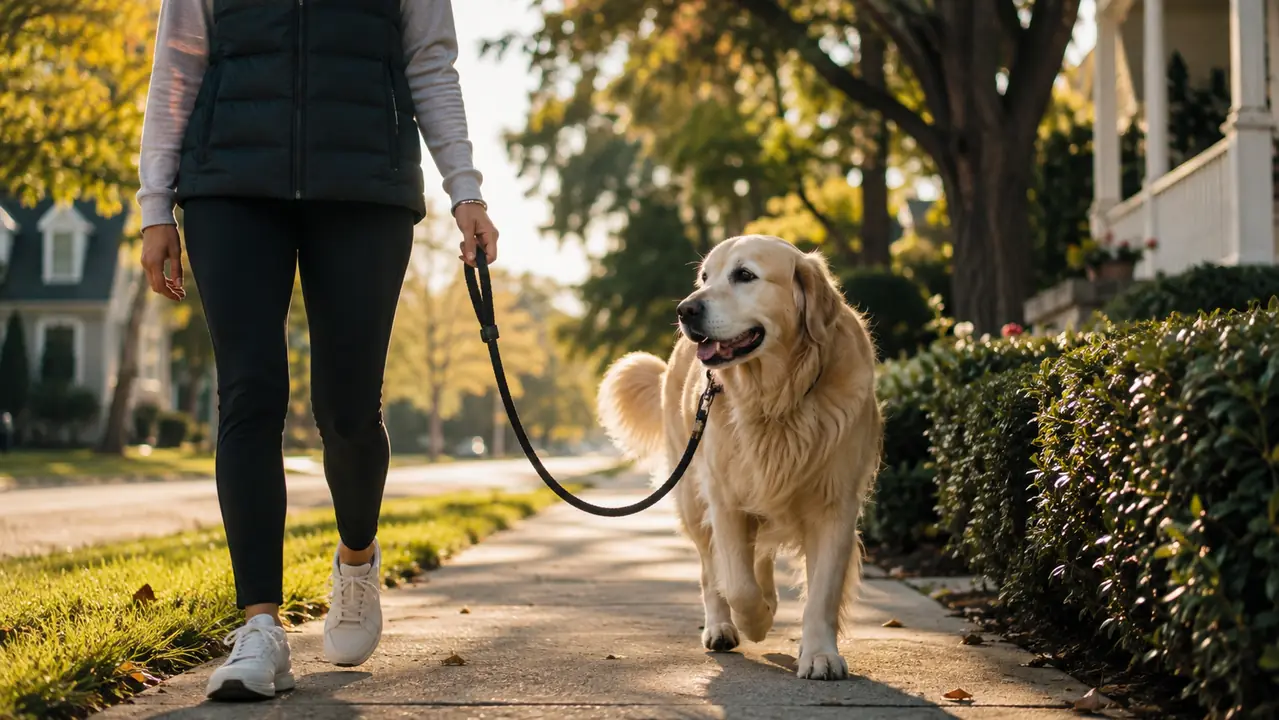
If you've walked a dog that pulls, you know the routine. Your arm is out at full length, your shoulder does the work, and every few steps you brace for another lurch toward a lamp post or a bush. Yelling "heel" doesn't reach a dog who is already past you and straining at the end of the lead, and leaning back just turns the walk into a tug of war nobody wins. The worst part is that the collar does nothing to stop it. A determined puller will choke himself hoarse and keep going, because getting to the fire hydrant is worth more to him than his comfort.
That's the moment a no-pull harness earns its spot in the drawer, and the rabbitgoo no-pull harness is the one I keep recommending. I want to be honest about one thing up front: a no-pull harness doesn't train the dog. You still have to teach loose-leash walking. What the harness does, and does well, is tip the physics in your favor. The leash clips to the chest instead of the collar or the back, so when a dog lunges forward, his own pull turns him back toward you instead of dragging you along. He has to stop and reorient himself, which gives you the pause you need to teach the actual lesson.
In the years I've spent around dogs and cats, the single biggest reason leash training stalls is that arms give out before patience does. A handler gets yanked so many times in one walk that they end the walk exhausted and start avoiding walks altogether. Then the dog never gets enough reps to learn. A front-clip harness removes that bottleneck, which is why it's the piece of gear I reach for first when somebody tells me their walks are getting shorter because their shoulder hurts. This article is the exact order I'd put the whole thing together in.
The front clip that turns pulling into a turn
On a strong puller, the rabbitgoo no-pull harness makes the first weeks of training genuinely easier. It has two leash clips, one at the chest and one at the back, so you can start on the front to steer and graduate to the back once the loose leash holds.
Amazon Check Today's Price on Amazon →Step 1: Get the fit right before you clip a leash on
The rabbitgoo no-pull harness is built for large dogs, so the first move is measurement, not guesswork. Put a soft tape around the widest part of your dog's chest, just behind the front legs, and check that number against the size chart. When you sit between two sizes, the adjustable straps usually make the smaller one the safer pick, because a strap that's run out of room can't be fixed at the start of a walk. It's the difference between a harness that fits all summer and one you have to reorder in a month.
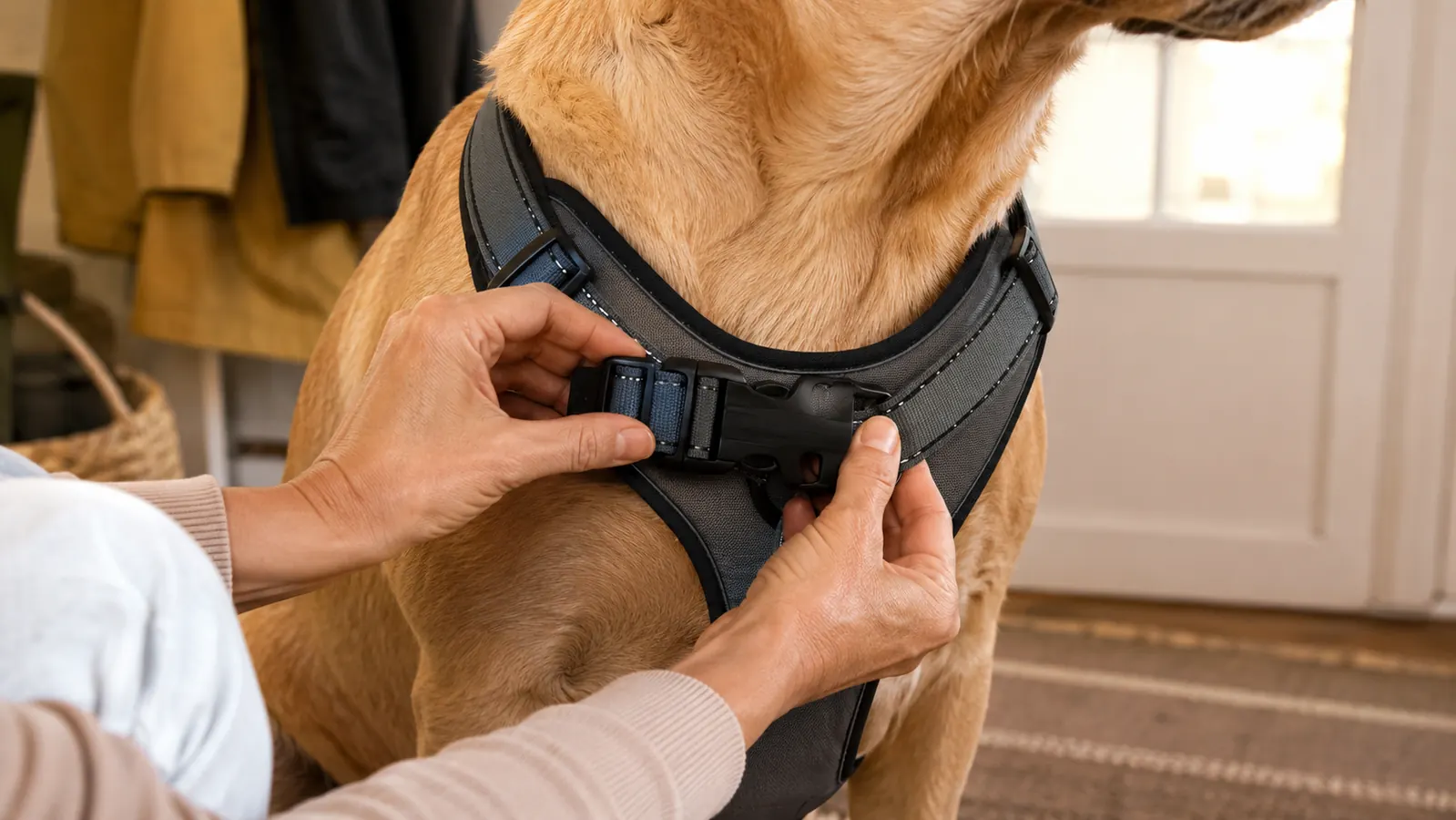
Once it's on, adjust both straps, one at the neck and one around the chest. The fit should be snug enough that you can slide two fingers under the padding, but not so loose that the whole thing shifts around as the dog moves. The straps on this harness tighten down fine and hold, which matters more than people expect, because a strap that slowly loosens mid-walk turns a good fit into a wobbly one by the second block.
A harness that fits poorly is a safety issue, not just a comfort one. Too loose and a determined dog can back right out of it, and watching a dog run into a busy street wearing nothing but a dangling leash is the worst possible outcome of this whole project. Too tight and it rubs under the front legs, and a dog that's uncomfortable in the harness learns to dread the thing before you've taught him a single lesson. Give fit its own session, with the treat pouch ready, so the harness itself becomes associated with good things.
Step 2: Start on the front clip
Here is the whole trick of a no-pull harness: this rabbitgoo has two leash rings, one on the chest and one on the back, and the front ring is the one that does the no-pull work. Clip the leash to the ring at the chest. When the dog strides past you and the leash tightens, his own forward momentum turns his body sideways, back toward you. He can't keep hauling forward, because the pull redirects him. The physics does the correcting for you, and it does it every single time, which is what a human arm can never promise.
Start every walk on the front clip while you're still building the habit. It's not a correction you have to deliver, and it isn't punishment. It works quietly and constantly, with the dog's own movement, so the pulling behavior stops being useful to him. A collar jerk punishes the dog for pulling without giving him a better option, so all he learns is that walks are unpleasant. The front clip gives the dog a clear way out of the discomfort: yield, and the pressure releases. Dogs choose the easy option every time.
One practical note on the front clip: expect the first couple of steps to feel strange for the dog. A dog who has always pulled will lunge, get turned, and then stand there for a second looking confused about why the world isn't moving the way he expects. That confusion is the lesson starting to land. Give him a quiet "good" when he turns, offer a treat at your knee, and start moving again. Most dogs catch on to the chest clip within a single walk.
Step 3: Make pulling stop working
The harness softens the pull, but the actual training lives in one simple rule: the instant the leash goes tight, you stop walking. Don't yank. Don't reel him in. Just stop and wait. Stand still until the dog turns back toward you and the leash goes slack again, and only then does the walk resume. That's the entire lesson, repeated over and over until it becomes the dog's default behavior.
Keep the lead short enough that there's no running start, but not so short it's always under tension. A six-foot lead held with a little slack gives the dog room to make the good choice without turning the walk into a constant tightening contest. The moment you feel pressure building through the handle, plant your feet. You're not dragging him back into position. You're simply making it true that walking forward is the reward, and only a loose leash produces forward motion.
The front clip makes this rule far easier to hold, because the dog interrupts his own lunge and comes around to face you instead of fighting you at full strength. If he does wrap around to face you, don't correct him for it. Quietly turn the other way and start walking, with him behind you, which is exactly where you want him to think the walk happens. Letting the dog feel the misplaced effort of going forward when you're going the other way teaches more in ten seconds than a lecture ever will.
Step 4: Reward the loose-leash moments
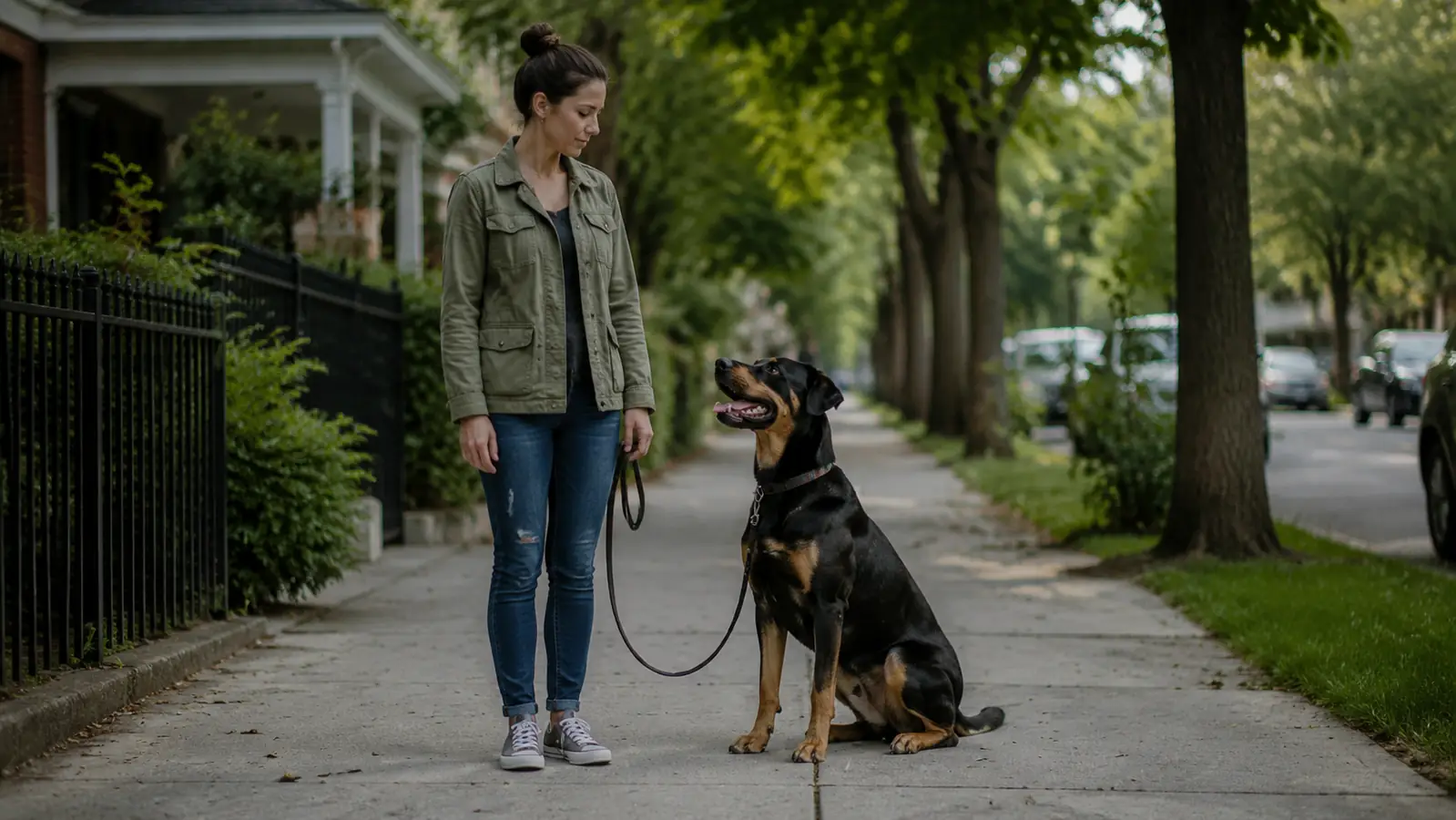
Stopping and starting is only half of it. The other half is catching the dog doing the right thing and rewarding it at the exact moment it happens. The second the leash slackens and the dog is beside you moving at an easy pace, that is when you act. A treat at your hip, a quiet "good," and continued forward movement all at once, and the dog gets a clear, immediate signal about which behavior is worth repeating.
Start somewhere deliberately boring. An empty driveway or a quiet side street has a fraction of the distractions a park has, and the dog can focus on the new rule instead of the whole world. Set the reward rate high early on, a treat every few seconds while the leash stays loose, so the dog sees walking beside you as the highest-paying activity available. Then space the treats out as the habit firms up, so he's not depending on a pocket full of food forever.
Build up to busier places only after the loose leash holds reliably in the quiet ones. Rushing this step is exactly how people end up with a dog that walks beautifully at home and pulls everywhere else, because the habit was never given a chance to stick before the difficulty went up. When you do level up to a busier street, keep the sessions short and drop the expectation for the first few minutes so it stays enjoyable for both of you.
Step 5: Graduate to the back clip once it holds
After a few weeks, once the loose leash is dependable on the front clip in most places, switch to the back clip for everyday walks. The back ring rides more naturally for long, relaxed walking once the pulling is gone, and the handle on top is handy for a quick steer across a street or to hold the dog still while you take a call. You'll still have the front clip available as a tool to bring back out on the high-arousal days, a new trail, a street full of dogs, a holiday weekend.
The switch doesn't have to be all at once. Many people run the back clip on morning walks, when the street is quiet, and drop back to the front clip for the evening walk, when everyone is out. That's a reasonable middle ground, and it lets the dog keep practicing the loose leash in the harder context while enjoying a normal-feeling walk in the easy one. Over time the evening walks will start staying loose too, and you can leave the carabiner clipped to the back.
You'll know it's working when a walk stops feeling like a workout. The leash hangs in a gentle U between you, and neither of you is leaning. That's the goal, and it's reachable with most dogs and enough patience. A dog with genuinely intense impulse issues may need a trainer, and there's no shame in that; plenty of dogs benefit from a professional pair of eyes who has seen a hundred hard pullers. The harness buys you the calm you need to teach, and a trainer can carry you the rest of the way.
What Else Helps
Keep the sessions short. Five focused minutes beats thirty minutes of frustration, and you can run a couple of them a day without burning anyone out. Stay consistent, the same rule every single time, because dogs learn rules faster than they learn exceptions. If standing still when the leash tightens is the rule on Tuesday, it has to be the rule on Friday too, or the dog just learns to gamble.
Skip the retractable leash for this kind of work. It fights everything you're teaching by letting the dog set his own comfortable length, which is always longer than you want, and the constant mild tension it puts on the line reads to the dog as a signal to keep pulling. Use a fixed six-foot lead until the behavior sticks. And carry a spare clip in your pocket, because a front ring that comes undone mid-walk is a no-pull harness that's just turned back into a collar for one walk.
The last thing worth saying is about expectations. Most dogs improve in days, not because the harness changes their brain but because it changes the odds. What you're really doing is making every walk the same lesson, repeated until it becomes the dog's default. Stick with the front clip, hold the stops, reward the slack, and the walk you remember from the start, all strain and teeth gritted, becomes the exception rather than the rule.
Stop the instant the leash goes tight, wait for slack, and only then move. On the front clip a dog interrupts his own lunge, so the rule is easy to hold instead of a full-strength wrestling match.
Give the front clip a real chance first
If your dog is still hauling you down the street, the cheap fix is a harness that lets you hold a training rule instead of a tug of war. The rabbitgoo no-pull harness is padded, adjusts to fit a range of large dogs, and carries the two clips you need to take a hard puller from front-clip steering to a calm back-clip walk.
Amazon Check Today's Price on Amazon →